
Applied AI for healthcare.
Health systems face a widening gap between clinical demand and clinical capacity — burned-out staff, mounting documentation burden, and razor-thin margins — while every new technology must meet a bar for patient safety, privacy, and clinical accuracy that leaves no room for error.

HIPAA-aligned deployments, private infrastructure, a signed Business Associate Agreement, and human-in-the-loop review on every decision that touches a patient — built for the standard clinical risk actually demands.



What we deliver for Healthcare & Life Sciences.
Clinical Documentation & Administrative Relief
AI that drafts notes, summarizes encounters, and handles intake paperwork in the background — giving clinicians back time for patients instead of screens, without changing how they chart.
Care-Team Copilots
A governed clinical assistant that surfaces relevant history, flags risk factors, and drafts recommendations at the point of care — every suggestion traceable to its source, every decision reviewed by a clinician.
Chronic Care & Remote Monitoring
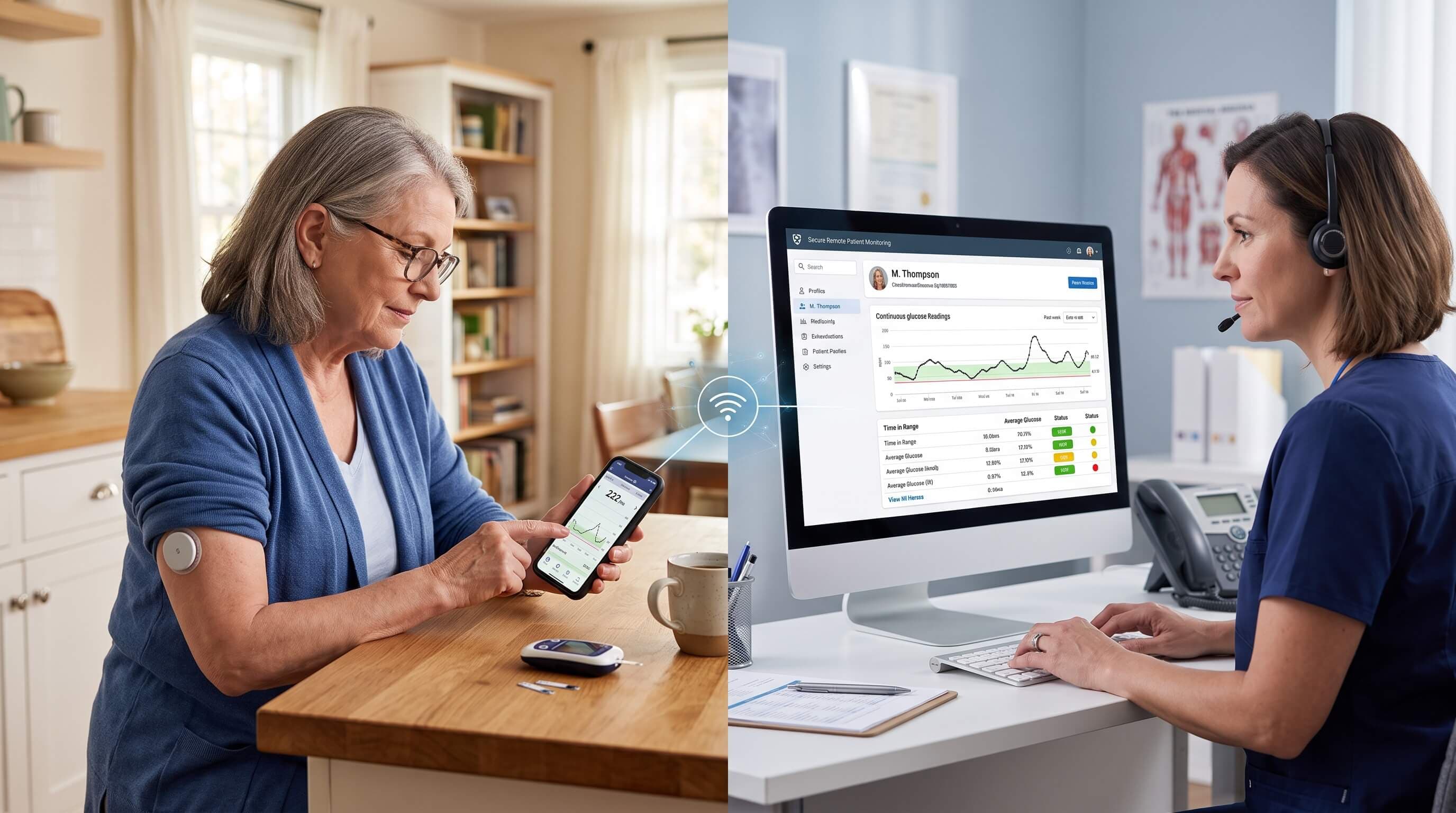
Continuous, AI-assisted monitoring for chronic-disease populations that flags deterioration early and routes the right cases to the right clinician, instead of treating every alert as equally urgent.
Clinical Research & Trial Matching
Automated screening against trial criteria and structured extraction from clinical notes — turning weeks of manual chart review into a process that keeps pace with your research pipeline.
Patient Intake, Scheduling & Prior Authorization
Conversational agents that handle intake, scheduling, and prior-authorization paperwork across phone, web, and messaging — reducing no-shows and administrative backlog without adding front-desk headcount.
HIPAA-Aligned, Auditable Infrastructure
Private infrastructure, a signed BAA, and immutable audit logs on every access to PHI — so compliance, risk, and legal can sign off with confidence, not with caveats.
Applied AI, mapped to your sector.



Where we help in Healthcare & Life Sciences.
HIPAA-aligned — AI on your most sensitive data.
Add named client logos and analyst recognition as they become available.
Frequently asked questions
How is patient data (PHI) protected, and will you sign a Business Associate Agreement (BAA)?
Yes — every healthcare deployment runs under a signed BAA on private, HIPAA-aligned infrastructure, with PHI encrypted at rest and in transit and access restricted to what each role explicitly needs.
Does this integrate with our EHR (Epic, Cerner, or other systems)?
Integration is built around your existing EHR and clinical systems using standard interfaces like HL7 and FHIR, so clinicians keep working inside the record they already use rather than adopting a separate tool.
How do we know the AI won't make a clinically unsafe recommendation?
Every clinical suggestion is paired with a traceable source in the patient record, and the system is designed for mandatory human review before any recommendation reaches a care decision — the AI supports the clinician's judgment, it never substitutes for it.
Is this a diagnostic tool, and what's our liability exposure?
Deployments are scoped as clinical decision support, not autonomous diagnosis — the clinician remains the decision-maker of record on every case, a deliberate design choice to keep liability and clinical accountability where they belong.
Will this add to clinician workload instead of reducing it?
The opposite is the design goal — documentation, intake, and administrative work move into the background so clinicians spend more time with patients and less time on screens; every workflow is validated with frontline clinicians before rollout, not just IT.
How do you prevent AI hallucination or fabricated clinical information?
Responses are grounded in your own clinical data and approved knowledge sources rather than open-ended generation, with confidence flags and source citations on every output so a clinician can verify before acting.
What happens during an EHR outage or system downtime?
The AI layer is built to degrade gracefully and never becomes a single point of failure for care delivery — clinical workflows continue to function through existing downtime procedures if the AI layer is unavailable.
How is this secured against ransomware and healthcare-specific cyber threats?
Private infrastructure, encrypted PHI, strict role-based access, and immutable audit logs minimize the attack surface that has made healthcare a leading ransomware target, with no dependency on unnecessary public exposure.
What's the implementation timeline for a health system our size?
Most systems start with a scoped pilot on a single service line or workflow (typically 4–8 weeks to first results), then expand site by site — so clinical and IT leadership can validate safety and adoption before a system-wide commitment.
How do we build the ROI case for our board or CFO?
ROI is tracked in concrete clinical-operations terms — clinician hours reclaimed, documentation time reduced, no-show and denial rates improved — with data captured from the pilot so the business case rests on your own numbers, not vendor estimates.
Will clinicians actually adopt this, or will it sit unused like other tools?
Adoption is treated as a clinical workflow problem, not a software rollout — tools are designed around how clinicians already work, piloted with frontline champions, and supported with hands-on training rather than a one-time demo.
Does this account for health equity and bias across different patient populations?
Models are evaluated for performance consistency across patient demographics before and during deployment, and human clinical review on every consequential decision is a deliberate safeguard against silent algorithmic bias.
Can this support multiple languages for a diverse patient population?
Yes — patient-facing intake, scheduling, and communication can operate in the languages your patient population needs, as a configuration choice rather than a separate build.
How do we maintain oversight of what the AI is allowed to access or do?
Every workflow is scoped to explicit, policy-defined boundaries your compliance and clinical leadership set — the AI cannot access records or take actions outside its approved mandate, and those boundaries are yours to adjust.
What does a pilot look like before we commit to a health-system-wide rollout?
A pilot targets one well-defined workflow — a single clinic, a single service line, a single administrative process — with clear before/after clinical and operational metrics, typically running 6–10 weeks, so leadership can evaluate real outcomes before scaling further.
See what AI in production looks like
Schedule a 30-minute call with our team. We'll show you real deployments, discuss your challenges, and map out a path to results.
Related insights
No content available for this category yet. Check back soon!