
How to Prepare for a Workplace Safety Audit
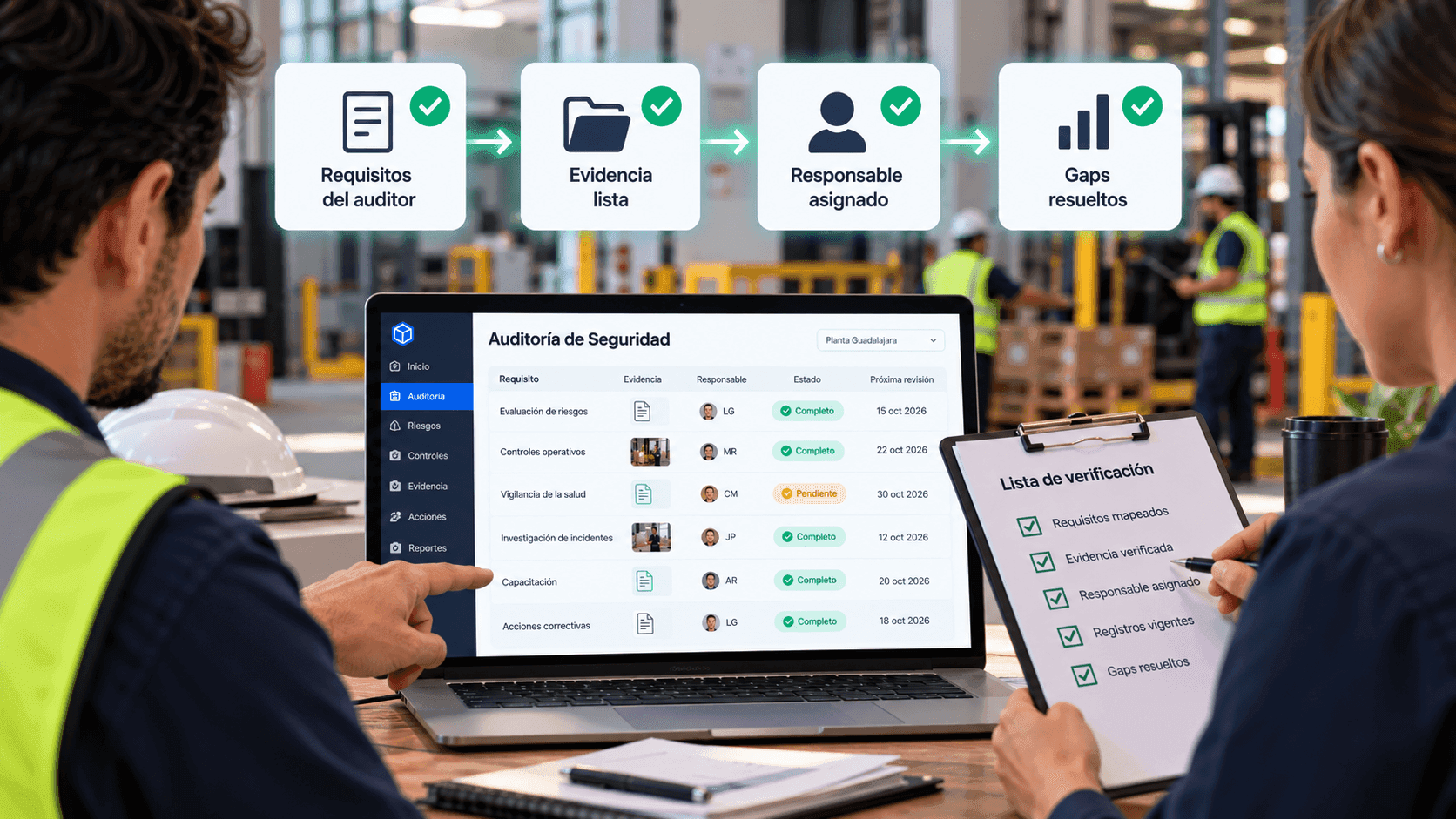
Preparing for a workplace safety audit means verifying that controls are operating—not simply gathering policies the week before. The most reliable approach is to map requirements to evidence, assign an accountable owner for each item, test whether records are current, and resolve gaps with documented corrective actions.
A strong audit process should also protect employee health data: auditors need appropriate evidence, not unrestricted access to clinical records.
1. Define the audit scope and requirements
Confirm what type of audit is taking place and which sites, processes, legal obligations, standards, or internal policies it covers. Different audits may examine workplace safety, environmental controls, occupational health, contractor management, emergency preparedness, or a combination of these.
Create a requirements matrix with four columns:

This prevents teams from treating the audit as a last-minute document request.
2. Validate evidence, not just documentation
A policy shows intent; evidence shows execution. For every important control, verify the policy or procedure, the latest implementation record, the assigned owner, and the review date.
Typical evidence may include:
- risk assessments and hazard registers; - inspection and maintenance records; - training and competency evidence; - incident investigations and corrective-action closure; - emergency drills and equipment checks; - contractor or visitor safety controls; and - records demonstrating occupational health surveillance where applicable.
If a record cannot be traced to a site, date, owner, and relevant requirement, it may not be defensible in an audit.
3. Review corrective actions before the auditor does
Open corrective actions are not automatically a failure. Unowned, overdue, or undocumented actions are the concern. Review actions from inspections, incidents, employee reports, previous audits, and management reviews.
For each action, confirm:
- the contributing cause was documented; - the action addresses that cause rather than only the symptom; - an accountable owner and due date exist; - completion has evidence; and - effectiveness was reviewed when the risk warrants it.
Escalate unresolved high-risk actions early. Do not mark an action complete merely because a task was assigned.
4. Check occupational health records with privacy in mind
For employers with health surveillance or fitness-for-work obligations, confirm that required processes are current and access is governed. The audit-ready view should demonstrate status, process ownership, and evidence without unnecessarily disclosing clinical details.
Verify role-based access, record-change history, retention rules, and the separation between operational reporting and confidential medical information. This is especially important when records are distributed across clinics, sites, or third-party providers.
5. Walk the operation as it actually runs
A desk review is not enough. Conduct a pre-audit walkthrough using the same routes, shifts, and work conditions the audit may cover. Compare records with observed practice.
Ask practical questions:
- Are controls visible and usable where work happens? - Do teams understand escalation and emergency procedures? - Are equipment checks completed when the record says they are? - Have new tasks, layouts, or contractors changed the risk profile?
The goal is to find a mismatch before it becomes an audit finding.
6. Prepare people, not scripts
Employees and managers should understand their responsibilities and know where to find the procedures that apply to them. Avoid rehearsed answers. A concise briefing on the audit scope, escalation paths, and evidence owners is more useful than a scripted presentation.
7. Establish one source of truth
When evidence is spread across paper files, email, spreadsheets, and site-level folders, teams lose time reconciling versions and proving ownership. A governed system can provide current status, role-based access, an audit trail, and a reliable link between risk, action, and evidence.
Nova Sentinel helps organizations track employee health history, assess EHS risk, and maintain compliance-ready documentation with auditability. At enterprise scale, Nova Cortex provides the governed platform foundation for connected workflows and data.
Before the audit: a final checklist
- Confirm scope, requirements, locations, and dates. - Assign one accountable owner for every evidence category. - Verify document versions and review dates. - Review open corrective actions and escalation status. - Test evidence against an operational walkthrough. - Confirm employee health information is shared on a need-to-know basis. - Establish a clear process for questions and follow-up during the audit.
FAQ
What is the difference between an EHS audit and an inspection?
An inspection usually checks site conditions at a point in time. An EHS audit evaluates whether the management system, controls, evidence, and accountability processes meet defined requirements.
How far in advance should a company prepare for a workplace safety audit?
Preparation should be continuous. A focused readiness review can occur before an audit, but records, controls, and corrective actions should be maintained throughout the year.
Can an auditor review employee medical records?
Access depends on applicable law, audit scope, and privacy controls. Organizations should provide the minimum appropriate evidence and preserve clinical confidentiality through role-based access and governed processes.
What commonly causes audit findings?
Common issues include out-of-date risk assessments, incomplete training evidence, overdue corrective actions, unclear ownership, and records that do not match operational practice.
Stay ahead in your industry
Subscribe and receive curated content about what's happening in your industry and news that can impact your business. No spam, just the good stuff!