What Should an Occupational Health Program Include?

An occupational health program should connect workplace risk assessment, employee health surveillance, prevention controls, incident follow-up, and auditable records. The goal is not to collect more documents; it is to show that the organization identifies risks, acts on them, and can demonstrate that control during an audit.
For employers with distributed operations, the program must also make ownership, review dates, access controls, and evidence consistent across sites.
1. A current view of workplace risks
Start with a documented inventory of the hazards employees may face by role, site, and task. This can include ergonomic, chemical, biological, noise, heat, fatigue, vehicle, or process-safety exposure.
A useful risk register identifies:
- the role or population exposed; - the hazard and its possible consequence; - existing controls; - the risk owner; - the review date; and - the evidence that the control is operating.
A register that is not reviewed after operational changes, incidents, or new equipment quickly becomes a compliance artifact rather than a management tool.
2. Employee health records with strict governance
Occupational health records should support fit-for-work decisions, required medical surveillance, restrictions, follow-up, and return-to-work processes. They are sensitive clinical data, so access must be limited by role and every relevant action should be traceable.
The program should define:
- what information is collected and why; - who can view, update, or approve it; - retention and deletion rules; - consent and privacy requirements applicable to the organization; and - an audit trail for record access and changes.
Do not use health information as a broad performance-management dataset. Separating clinical confidentiality from operational reporting is a core governance control.
3. Prevention and control plans
For each material risk, define the control plan: engineering changes, procedures, training, protective equipment, inspections, or medical surveillance as appropriate. Each control needs an owner and a method to verify it happened.
For example, if repetitive lifting is a material risk in a warehouse, a program can track the assessed task, workstation changes, training completion, observed conditions, restrictions, and review cadence. It should not assume a one-time training session proves a risk remains controlled.
4. Incident, absence, and return-to-work follow-up
A complete program captures relevant incidents and trends, investigates contributing factors, assigns corrective actions, and tracks closure. It also establishes a consistent process for occupational absences and safe return to work.
This creates a feedback loop: repeated events, unresolved actions, or site clusters can trigger a risk review before the next serious event or audit.
5. Compliance-ready evidence
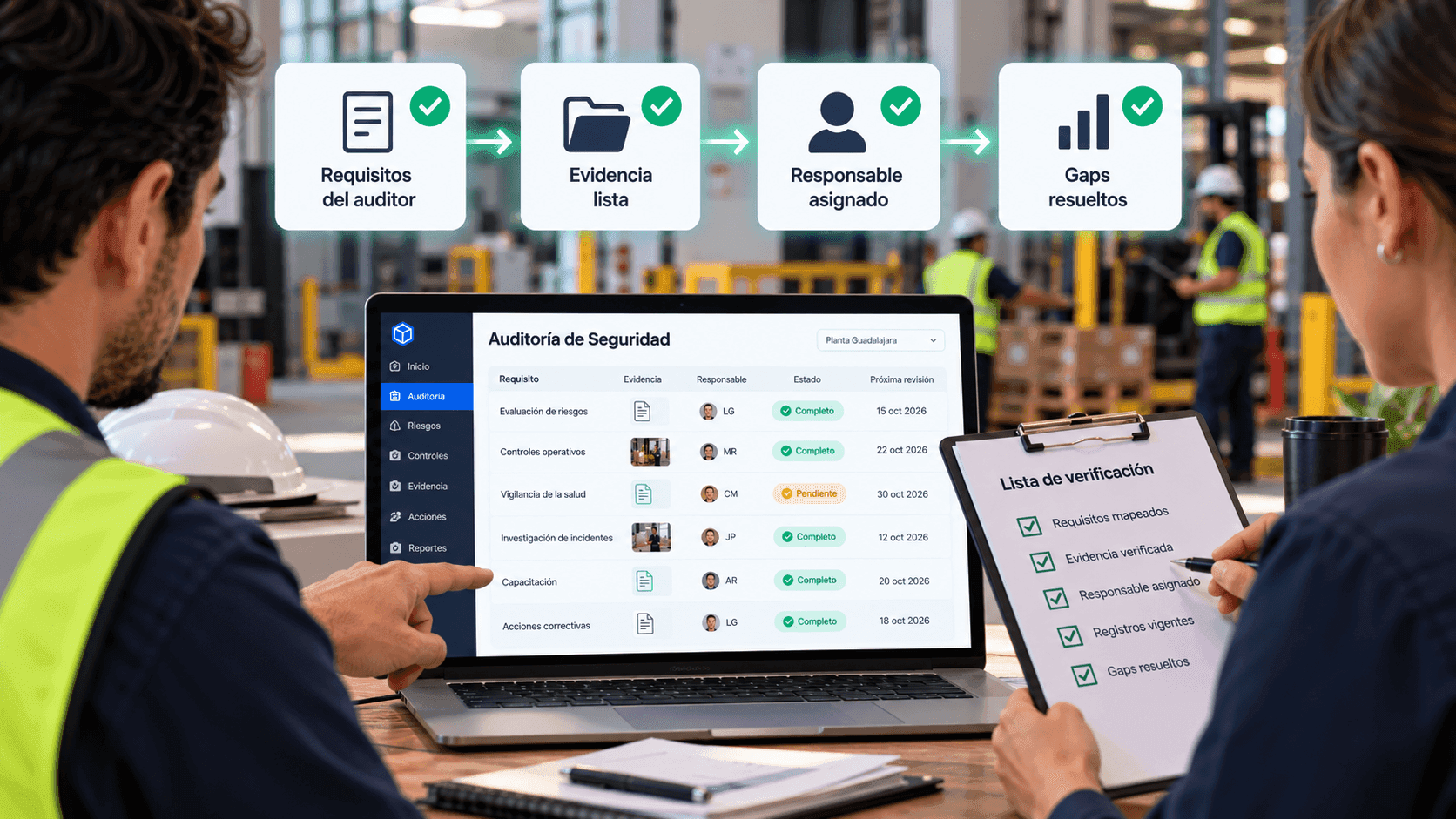
Auditors commonly need to see more than policies. They need evidence that required processes are current and operating. Keep policies, assessments, training records, medical-surveillance status, inspections, corrective actions, and approvals linked to dates and accountable owners.
A practical rule: every control should answer three questions—who owns it, when was it last verified, and where is the evidence?
6. Reporting that supports decisions
Leadership reporting should make exposure and control gaps visible without exposing unnecessary clinical detail. Useful views may include overdue assessments, expiring surveillance requirements, unresolved corrective actions, high-risk locations, and patterns that warrant review.
The emphasis is on prevention and accountability, not on generating more dashboards.
Where software helps
Occupational health software can centralize records, control role-based access, maintain audit trails, and connect health processes to EHS risk management. The right system should fit the organization's regulatory context and data-governance requirements, not force sensitive health data into a generic workflow tool.
Nova Sentinel helps organizations maintain a governed employee health history, surface EHS risk, and prepare compliance-ready documentation. For organizations operating at scale, it can connect to Nova Cortex for a governed AI foundation.
Next step
If your program relies on disconnected spreadsheets, paper files, or site-specific processes, begin with a gap assessment: identify the risks, records, controls, and evidence that cannot currently be verified. Then prioritize the gaps with the highest compliance and workforce impact.
FAQ
Is an occupational health program the same as an EHS program?
No. Occupational health is a major part of EHS, focused on protecting worker health and managing workplace exposure. EHS also includes broader environmental and safety responsibilities.
How often should an occupational health risk assessment be reviewed?
Review it on a defined schedule and whenever a material change occurs, such as a new process, equipment, incident, work pattern, or regulatory requirement.
What is the most important control for employee health records?
Role-based access with a reliable audit trail. Sensitive health data should only be available to people with a legitimate, defined need to access it.
Can AI replace occupational health professionals?
No. AI can help organize evidence, identify patterns, and prioritize review, but clinical and compliance decisions require appropriate qualified oversight.
Stay ahead in your industry
Subscribe and receive curated content about what's happening in your industry and news that can impact your business. No spam, just the good stuff!